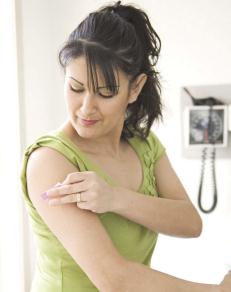
V
accines can prevent many illnesses. Some of
those vaccines—like the one for u—are well
known. But others—like the pneumococcal vac-
cine—don’t seem to get the same attention. is
vaccine helps prevent pneumonia. You and your
family may be among those who should get the
shot.
A bad bug
Like the u, pneumonia can make you very sick.
It causes the air sacs in your lungs to ll with pus
and liquid. at makes it hard for oxygen to get into
your bloodstream and for your body’s cells to work
the way they should. In some cases, pneumonia
can lead to death.
Very young children and older adults are at great-
est risk of getting pneumonia. People with chronic
health problems and weak immune systems are
also at great risk.
Staying safe
ere are two pneumonia vaccines.
One is for children only. It protects against the
strains of bacteria that cause the most severe infec-
tions in kids. Most kids get this vaccine in four
doses starting when they’re 2 months old. ey
get the last dose when they’re between 12 and 15
months old.
Children younger than 5 years who didn’t get the
vaccine on schedule can still be protected. ey
won’t need four doses, though.
e second type of pneumonia vaccine is
mainly for adults. Kids 2 years and older who
are at high risk are also given it as added
protection.
Adults who should get it include those who:
»
Are 65 years of age and older.
»
Have long-term health problems, such as heart or
lung disease, asthma, or diabetes.
»
Would have a hard time ghting an infection
because of illness or its treatment.
»
Smoke.
Most people need only one dose of this pneumonia
vaccine. Some people, though, will need a second
dose. If so, you get it ve years after the rst one.
Both pneumonia vaccines are considered very safe.
Side eªects may include pain or redness at the site
of the shot and a fever.
Are you protected?
Talk to your doctor to learn more. Ask if or when you
or your loved ones should get this vaccination. For
more information about the pneumonia vaccine and
other immunizations, call the Los Angeles County
Department of Public Health at
213-351-7800
or
visit
www.publichealth.lacounty.gov/ip
.
Sources: American Lung Association; Centers for Disease Control and Prevention;
Immunization Action Coalition
The 411 on flu
The Centers for Disease Control and
Prevention (CDC) recommends a yearly fu
vaccine for everyone 6 months and older.
In addition, you can take everyday preven-
tive actions:
»
Stay away from sick people.
»
Wash your hands to reduce the spread
of germs.
»
If you are sick with fu, stay home from
work or school.
If you are age 65 years or older
People 65 or older are at greater risk of
serious complications from the fu com-
pared with young, healthy adults. About
90 percent of seasonal fu-related deaths
and more than 60 percent of seasonal fu-
related hospitalizations each year occur in
people 65 and older.
»
Get a fu vaccine as soon as it becomes
available.
»
Take everyday precautions—cover
coughs, wash hands often and avoid
those who are sick.
»
Seek medical advice quickly if you de-
velop fu symptoms.
Know the symptoms
Flu symptoms include fever, cough, sore
throat, runny or stuffy nose, body aches,
headache, chills and fatigue. Some people
may also have vomiting and diarrhea and
others may have respiratory symptoms
without a fever.
While there are many different fu viruses,
the fu vaccine is designed to protect
against the three main fu strains that re-
search indicates will cause the most illness
during the fu season.
Health and Wellness
PNEUMONIA—
WHO NEEDS THE SHOT?
6
NEED A FLU SHOT?
For information on flu shot clinics in the San
Gabriel Valley, call the Monrovia Public Health
Center at 626-256-1600. For information on
Methodist Hospital fu shot clinics for seniors, call
626-821-6978. You can also visit www.publichealth
.lacounty.gov/ip/flu/FluLocatorMain.htm.
50
+
HEALTH CONNECTION CORNER
For information on future senior seminars, please
call Arlene Okamoto at 626-821-6978.